How Afghanistan’s Transformation Is Reshaping South Asian Security in South Asia
Afghanistan’s political shift has changed more than who governs Kabul. It has changed how South Asian states think about borders, militant networks, refugees, trade routes, intelligence work, and the balance between engagement and isolation.
Since the Taliban returned to power in 2021, Afghanistan has moved from a state backed by Western military and financial support to one run by a regime that remains largely unrecognized by the world. That shift has created a new security puzzle. The old framework, built around counterterrorism partnerships, foreign aid, and NATO operations, no longer applies. The new one is more fragmented, more regional, and harder to manage.
For South Asia, Afghanistan is not a distant crisis. It sits near the fault lines that shape Pakistan’s internal security, India’s regional strategy, Central Asian connectivity, and China’s western border concerns. What happens inside Afghanistan now moves quickly across the region.

Afghanistan has become a regional test of power and restraint
Afghanistan has long acted as a buffer, a corridor, and a pressure point. Its location links South Asia, Central Asia, and the Middle East. That makes every major change in Kabul a regional event.
The Taliban’s return changed the basic security equation in three ways.
First, it removed the foreign military presence that had shaped Afghan security policy for two decades. Regional states now have to deal directly with the authorities in Kabul, even when they do not formally recognize them.
Second, it brought back a governing movement with close historical ties to armed groups in the region. The Taliban has tried to present itself as a national government, but its past relationships still shape how neighbors view its intentions.
Third, Afghanistan’s economic crisis has weakened the state’s ability to control territory, manage borders, and provide basic services. Even where the Taliban has improved some forms of internal control, the country remains under financial strain.
That mix has created a difficult question for South Asian governments: Should they engage Kabul to reduce risks, or isolate it to avoid legitimizing Taliban rule?
Most have chosen a middle path. They maintain contact, send humanitarian aid, discuss security concerns, and avoid full recognition. This allows practical cooperation, but it does not solve the deeper problem. Afghanistan’s transformation has created a government that regional states must deal with, yet few are willing to endorse.
That tension lies at the center of South Asian security in South Asia today.
Pakistan faces the sharpest security spillover
No country feels Afghanistan’s transformation more directly than Pakistan. The two share a long and difficult border, deep ethnic ties across the frontier, and decades of uneasy involvement in each other’s internal politics.
For years, many analysts assumed that a Taliban-led Afghanistan would give Pakistan strategic depth and reduce pressure along its western flank. The reality has been more complicated.
Pakistan’s main concern is the Tehrik-i-Taliban Pakistan, commonly known as the TTP. The group is separate from the Afghan Taliban, but it shares ideological roots and has historically used Afghan territory as a space to regroup. Since the Taliban took power in Kabul, Pakistan has accused militants based in Afghanistan of carrying out or supporting attacks inside Pakistan. The Afghan Taliban has denied allowing Afghan soil to be used against others, but trust remains low.
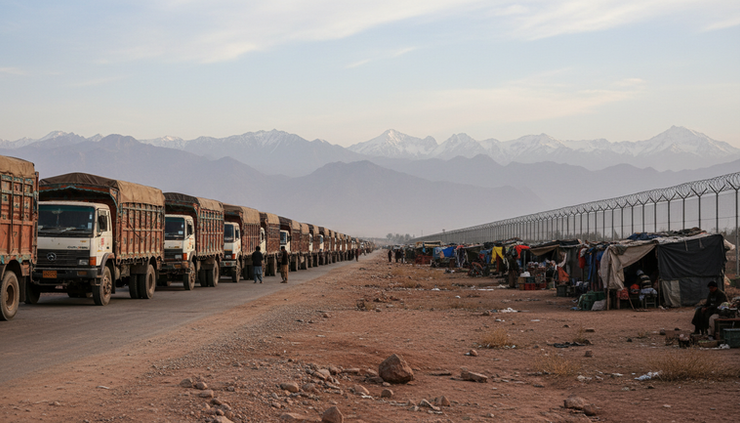
This has created a new strain between Islamabad and Kabul. Border closures, cross-border firing, and disputes over the Durand Line have become part of the relationship. Pakistan has also increased pressure on undocumented Afghan migrants, a move it frames as a security measure but one that carries major humanitarian costs.
The security impact goes beyond militant attacks. Pakistan must now manage several linked pressures:
A tense western border that diverts attention and resources.
Refugee movements that affect cities, border districts, and local economies.
Public frustration after years of violence linked to militant groups.
A difficult diplomatic relationship with a Taliban government it once had more influence over than it does today.
The irony is clear. Pakistan gained a friendly-seeming government in Kabul, but it did not gain a quiet border. In some ways, it inherited a more unpredictable one.
India is balancing caution with limited engagement
India’s position is different from Pakistan’s, but no less important. Afghanistan has long mattered to India for security, diplomacy, and connectivity. Before 2021, India invested in Afghan infrastructure, education, and development projects. It also built ties with the former Afghan government.
The Taliban’s return forced New Delhi to reset its approach.
India has not recognized the Taliban government, but it has reopened limited diplomatic contact and sent humanitarian assistance, including food and medical supplies. This reflects a practical calculation. India does not want to abandon the Afghan people or leave the field entirely to Pakistan, China, or other regional actors.
Security concerns still shape India’s caution. New Delhi worries that Afghanistan could again become a safe space for groups hostile to India. The memory of past attacks linked to Pakistan-based militant networks remains central to Indian thinking. Even if the Taliban seeks international acceptance, India will judge Kabul by whether it prevents anti-India groups from operating.
Afghanistan also affects India’s access to Central Asia. Because India does not have direct land access through Pakistan, it has looked to alternatives such as Iran’s Chabahar port and routes that connect to Central Asia. A stable Afghanistan could support regional trade. An unstable Afghanistan makes those plans harder.
India’s strategy now rests on a careful mix:
Engage enough to protect interests
Avoid full political endorsement
Watch Pakistan’s role closely
Keep regional options open
Maintain channels with Kabul, support humanitarian needs, and monitor threats.
Hold back recognition while the Taliban restricts rights and excludes many Afghans from power.
Track whether Afghan territory becomes part of a wider security challenge.
Work with Iran, Central Asian states, Russia, and the United States where interests overlap.
This is not a comfortable position, but it is realistic. India has learned that distance from Afghanistan does not guarantee safety from Afghan instability.
Militant groups remain the core regional concern
The biggest security question is whether Afghanistan can prevent transnational militant groups from operating on its soil.
The Taliban has an incentive to stop groups that threaten its rule or invite foreign pressure. It has fought the Islamic State Khorasan Province, known as ISKP, which opposes the Taliban and has carried out deadly attacks in Afghanistan. ISKP threatens minorities, Taliban officials, foreign missions, and regional states.
At the same time, the Taliban’s relationships with other armed groups are more complex. Some groups share history, ideology, personal ties, or battlefield experience with Taliban factions. That makes enforcement uneven and opaque. Regional governments do not always know whether Kabul cannot control certain groups or chooses not to act against them.
This uncertainty affects decisions across South Asia.
For Pakistan, the TTP is the immediate concern. For India, anti-India militant networks are the main fear. For China, groups linked to Uyghur militancy and instability near Xinjiang drive concern. For Iran, border security, narcotics, water disputes, and the treatment of Shia communities matter. For Central Asian states, the risk is the spread of extremism or cross-border attacks into their territory.
The problem is not that Afghanistan is certain to become the same kind of militant hub it was before 2001. The problem is that the region has no trusted system to verify what is happening inside the country.
There are no foreign troops on the ground. Intelligence access is limited. The Taliban’s internal decision-making is hard to read from outside. Regional states often rely on their own channels, local contacts, or narrow security talks with Kabul.
That creates space for suspicion. In South Asia, suspicion can be as destabilizing as confirmed evidence.

Economics and humanitarian pressure are now security issues
Afghanistan’s economic collapse is often described as a humanitarian crisis, and it is. But it is also a security issue.
When a state cannot support livelihoods, people move. Smuggling grows. Armed groups recruit more easily. Local communities become more vulnerable to coercion. Border economies become harder to manage.
After 2021, Afghanistan lost much of the foreign aid that had supported public services and government salaries. Banking restrictions, sanctions concerns, and the lack of recognition made normal economic activity harder. The Taliban has collected customs revenue and imposed order in some areas, but that has not solved the national economic crisis.
Women’s exclusion from many areas of education and work has also damaged Afghanistan’s prospects. It reduces household income, weakens public services, and limits the country’s access to international support. A society that sidelines half its population cannot build stable long-term security.
Refugee flows add another layer. Pakistan and Iran have hosted large Afghan populations for decades. Both countries face their own economic pressures and have tightened policies at different times. Large returns to Afghanistan can strain communities that already lack jobs, housing, and services.
Narcotics also remain part of the security picture. The Taliban has announced bans on opium cultivation, and reports have indicated major reductions in cultivation in some areas. Yet sudden bans can also hurt rural communities that depended on poppy income. If farmers lose income without alternatives, illicit networks may shift activities rather than disappear.
Security planning often focuses on weapons and borders. Afghanistan shows why that is too narrow. Food prices, work permits, water access, and education policy can shape regional stability as much as military patrols do.
China and Central Asia are more involved, but still cautious
Afghanistan’s transformation has also pulled China and Central Asian states more directly into the security debate.
China’s main goal is stability. It worries about militancy spilling into Xinjiang, attacks on Chinese interests, and the safety of regional infrastructure projects. Beijing has maintained contact with the Taliban and has shown interest in Afghanistan’s mineral wealth and transport potential. Yet it has moved carefully. Afghanistan’s security risks, weak banking system, and uncertain legal environment make large-scale investment difficult.
Central Asian states have also taken practical steps. Uzbekistan and Turkmenistan have kept channels open with Kabul because trade, electricity, transport, and border security require contact. Tajikistan has taken a more critical stance, in part because of concerns about ethnic Tajiks in Afghanistan and militant risks along the border.
These countries do not see Afghanistan only through a South Asian lens. They see it as part of a wider Eurasian security zone. Still, their actions affect South Asia. If northern trade routes grow, India and Pakistan will adjust their strategies. If militancy spreads northward, the entire region will face stronger pressure for security coordination.
The broader lesson is that Afghanistan is no longer managed through a single international framework. It is now handled through overlapping regional relationships, each with its own priorities.
That can create flexibility. It can also create confusion.
The old security model has been replaced by fragmented engagement
Before 2021, South Asian states dealt with Afghanistan through a system heavily shaped by the United States and its allies. That model had flaws, but it created a central point of coordination. After the withdrawal of foreign forces, there is no single organizing power.
Now each country is building its own approach:
Pakistan seeks action against the TTP while trying to keep influence in Kabul.
India keeps limited engagement while watching for anti-India threats.
China pursues stability and narrow security assurances.
Iran focuses on borders, water, refugees, and minority protections.
Central Asian states prioritize trade, electricity, and frontier security.
Western countries remain focused on counterterrorism, rights, and humanitarian aid.
These efforts sometimes overlap, but they do not form a shared plan.
The risk is that Afghanistan becomes a space where every neighbor works separately, and militant groups exploit the gaps. A purely punitive approach could push Kabul inward and worsen humanitarian conditions. A purely accommodating approach could reward harmful policies and leave security concerns unresolved.
The region needs a more disciplined middle course. That does not require full recognition of the Taliban. It does require regular communication, clear demands, and practical cooperation where lives and security are at stake.
Useful steps would include:
More consistent regional talks on counterterrorism concerns.
Humanitarian aid channels that do not strengthen abusive practices.
Support for Afghan livelihoods, especially alternatives to illicit economies.
Clear pressure for girls’ education and women’s access to work.
Border management that protects security without punishing civilians as a group.
Shared monitoring of militant threats where trust allows it.
None of this is easy. South Asia carries deep rivalries, especially between India and Pakistan. Those rivalries make regional cooperation hard even when interests overlap. Yet Afghanistan’s instability does not respect those political boundaries.
The takeaway for South Asian security
Afghanistan’s transformation has not produced a single, clear outcome. It has created a moving set of risks.
The Taliban controls Kabul, but recognition remains limited. Pakistan has influence, but not control. India is cautious, but not absent. China is engaged, but not fully committed. Iran and Central Asia are involved because geography leaves them no choice.
This makes Afghanistan one of the region’s hardest security tests. The question is not only whether the country becomes stable. The question is whether its neighbors can manage their fears without turning Afghanistan into another arena for rivalry.
A safer path will require patience, pressure, and practical contact. Regional states must judge Kabul by behavior, especially on militant groups, rights, and cross-border threats. At the same time, they cannot ignore the Afghan population’s economic and humanitarian needs.
Afghanistan’s transformation is reshaping South Asian security because it has changed the region’s basic assumptions. Borders look more fragile. Non-state armed groups matter more. Economic collapse has become a security concern. Diplomacy now happens without trust, but with no real alternative.
The countries that understand this will treat Afghanistan not as a problem to contain from a distance, but as a regional reality that demands steady, careful management.


Comments